

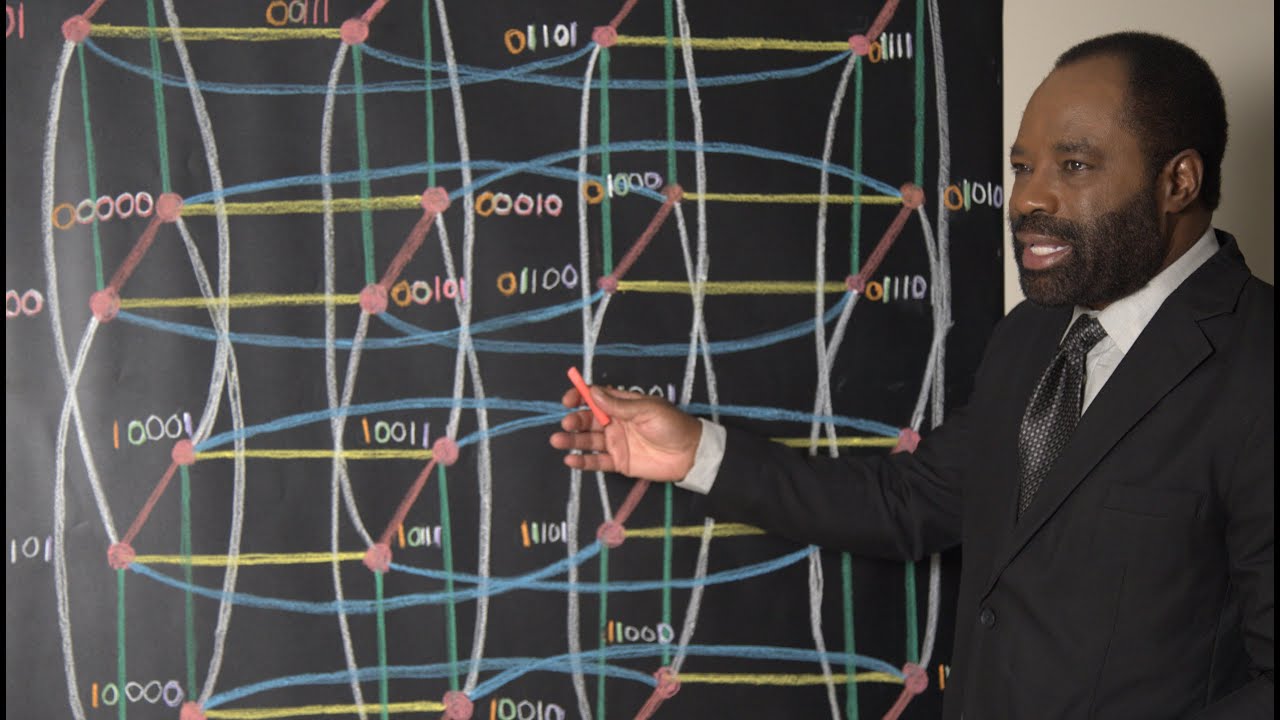
 I’m Philip Emeagwali at The parallel supercomputer
 is used to accelerate
the rate of discovery of new compounds, new materials, new physics,
new mathematics, and of course,
new computer science.
The invention of parallel processing
opened a doorway
to a new world in supercomputing
that is called
extreme-scale computational physics.
That new parallel processed pathway leads to the emerging fields
of supercomputing the weather
for above and below
the surface of the Earth.
Parallel processing
is the vital technology
that opened new possibilities
that were essential to the development of new sciences, new technologies,
and new fields of study.
Parallel processing
made the impossible-to-solve
possible-to-solve.
Parallel processing
widened our horizons
and changed the way
we looked at the computer
and the supercomputer.
Parallel processing
enabled the supercomputer scientist
to produce new facts, new mathematics, and new physics.
The parallel supercomputer
brought an enrichment of meanings
in the sciences.
The parallel supercomputer
is the universal enabler
of mathematics and science.
Supercomputing Down Memory Lane
The first supercomputer
that I began programming—back on June 20, 1974—was locked away
in the bowels of the building
at 1800 SW Campus Way,
Corvallis, Oregon, United States.
The supercomputer
is not used for writing letters
or doing taxes or planning a vacation.
Since 1957, the supercomputer
was programmed
by an exclusive priesthood
who were versed in a language
called FORTRAN.
The term FORTRAN is the acronym for
FORmula TRANslation.
I was one of those
supercomputer priests
that was at home with FORTRAN.
By the late 1970s and early ‘80s,
I was programming
the fastest computers
in the Foggy Bottom neighborhood
of Washington, District of Columbia
and in College Park, Maryland.
Back from mid-1977 through mid-1980s, the research laboratories
that were active in supercomputing
and that were a short bus ride
from my residences
in the Adams-Morgan neighborhood
of Washington, DC
and near the Silver Spring Metro Station,
include the National Security Agency
in Fort Meade, Maryland;
U.S. Naval Research Laboratory
in Washington, DC;
U.S. Army Aberdeen Proving Ground
in Aberdeen, Maryland;
David Taylor Model Basin
in Bethesda, Maryland;
National Institute of Standards
and Technology
in Gaithersburg, Maryland;
and NASA Goddard Space Flight Center
in Greenbelt, Maryland.
Back then, I was programming
the fastest computers
and doing so to solve linear systems
of equations
that arose in extreme-scale algebra
that, in turn, arose from
my finite difference discretizations
of the partial differential equations
that I invented
and that governed
initial-boundary value problems
of physics and calculus.
As a mathematical aside,
the differential equation
is the most recurring decimal
within the grand challenge problems
solved in all supercomputers
and solved
since the first automatic computer
was invented in 1946.
A New Era of Computing
My discovery
of how practical parallel supercomputing
can be used
to solve grand challenge problems
was a breakthrough
that was important enough
to make the news headlines.
That particular discovery
of practical parallel supercomputing
that occurred on the Fourth of July 1989 opened the door
for the modern supercomputer
that is powered by millions of processors
that is used to cooperatively solve
real world problems.
That discovery
made the news headlines because
it enabled us to see computers
and supercomputers
in a different way, namely,
as parallel processing
or solving a million problems
at once,
instead of solving only one problem
at a time.
What Does a Supercomputer Look Like?
What does the world’s fastest supercomputer
look like inside?
The world’s fastest supercomputer
occupies the space of a soccer field
but yet its crown jewel,
called parallel processing,
has 200 miles of email cables
that remains invisible.
Back in the 1970s,
only a few computer scientists
had seen and programmed
the most massively parallel supercomputer in the world.
For information about Philip Emeagwali,
TOPICS
Philip Emeagwali, supercomputer, father of the modern supercomputer, Philip Emeagwali Computer, world's fastest supercomputer, parallel processing, high performance computing, parallel computing, massively parallel supercomputers, Philip Emeagwali Supercomputer, Philip Emeagwali Machine, vector processors, vector supercomputers
Philip Emeagwali 190929 2 4 of 5


0 Comments